
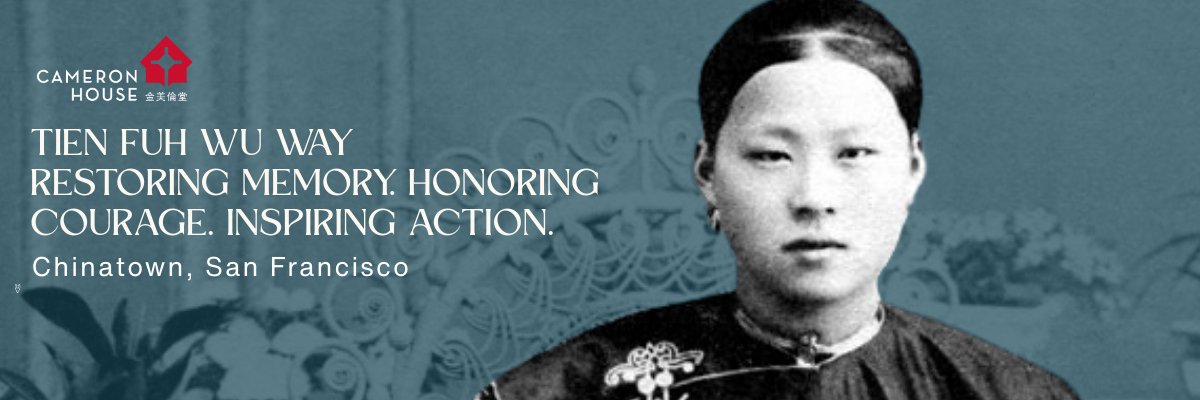
The block of Joice Street between Sacramento and Clay Streets has been commemoratively re-named Tien Fuh Wu Way.
Born into indentured servitude and rescued as a child, Tien Fuh Wu—or Auntie Wu as she was known to many of Cameron House’s girls and women—became a central leader in San Francisco’s early anti-trafficking movement. Fluent in Cantonese and deeply trusted by survivors, she worked tirelessly to protect women and girls from exploitation.
Joice Street holds historic meaning. It was once a place where rescued girls, Tien Fuh Wu included, played, laughed, and found moments of safety.
Little is known about Tien Fuh Wu, especially when compared to the iconic Donaldina Cameron, but her impact on San Francisco’s Chinatown is larger than life. This commemorative renaming is just the beginning of the recognition that Tien Fuh Wu deserves.
Upcoming Celebrations
- March 6 — Tien Fuh Wu Way sign unveiling and neighborhood ceremony
- March 19 – Tien Fuh Wu honored posthumously at Cameron House’s annual gala
- May 30 – Tien Fuh Wu Day of Service
Join us this Women’s History Month as we turn history into action.
Learn more about Tien Fuh Wu, her work, and the time in which she lived and worked here:
- The White Devil’s Daughters: The Women Who Fought Slavery in San Francisco’s Chinatown, by Julia Flynn Siler
- Chinatown’s Angry Angel: The Story of Donaldina Cameron, by Mildred Crowl Martin
- Unsung Heroines: 35 Women Who Changed the Bay Area, by Rae Alexandra
- The Child Slave Who Helped Rescue Thousands of Women in Chinatown, by Rae Alexandra
Frequently Asked Questions (FAQ)
1. Why rename Joice Street? Isn’t this unnecessary?
The commemorative renaming of Joice Street to Tien Fuh Wu Way is about restoring historical recognition to a woman whose leadership profoundly shaped San Francisco’s early anti-trafficking movement. While Donaldina Cameron is widely remembered, Tien Fuh Wu—herself a survivor—was central to protecting women and children from exploitation.
Public spaces reflect whose stories we value. Honoring Tien Fuh Wu ensures that Asian American women and survivors are visible in the civic landscape and that their contributions are not erased from history.
2. Is Joice Street being removed or changed officially?
No. This is a commemorative renaming, meaning Joice Street remains the official address. Residents and businesses do not need to change mailing addresses or legal documents. The commemorative sign adds recognition without creating logistical burdens.
3. Why focus on Tien Fuh Wu instead of Donaldina Cameron?
Donaldina Cameron’s legacy is already widely recognized. Tien Fuh Wu’s story, however, has often been overlooked despite her indispensable role.
As a Chinese woman, survivor, interpreter, educator, and advocate, she was uniquely positioned to earn the trust of rescued girls and ensure their safety. Honoring Tien Fuh Wu uplifts the leadership of Asian American women and restores balance to a narrative that has historically centered others.
Both women’s legacies are deeply intertwined and mutually honored through this recognition.
In addition, notable women like Donaldina Cameron and Julia Morgan, the architect behind Cameron House, both have San Francisco streets commemoratively named for them. It is with deep pride that we extend this honor to a Chinese woman.
4. Why is this important today?
Human trafficking, gender-based violence, and exploitation remain global issues. Honoring Tien Fuh Wu reminds us that survivor-centered advocacy and culturally competent care have long been part of San Francisco’s history.
For Asian American youth—especially girls—seeing someone who shares their heritage honored publicly strengthens cultural pride, civic belonging, and confidence in leadership.
5. Are there more urgent issues the community should focus on?
Communities can address immediate needs while also investing in long-term cultural equity. This initiative does not replace social services, mental health advocacy, or immigrant safety efforts—it complements them.
Representation in public spaces shapes how young people see themselves and their place in society. Elevating overlooked Asian American women leaders reinforces dignity, belonging, and collective memory.
6. Was the community consulted?
Yes. The initiative involved collaboration with city leadership and community partners. The commemorative approach was selected specifically to avoid imposing burdens on neighbors while ensuring lasting recognition.
The broader celebration—including a Day of Service—invites ongoing community participation and shared ownership of this legacy.
7. Why choose Joice Street specifically?
Joice Street holds historical significance. It was once a place where girls living at Cameron House could play and reclaim moments of childhood safety after trauma. Naming the street after Tien Fuh Wu transforms that physical space into a permanent symbol of resilience, healing, and hope.
8. Does this erase other histories in Chinatown?
No. Chinatown’s history is layered and complex. This recognition adds to the story rather than replacing it. Public memory grows stronger when it becomes more inclusive—especially of women, children, immigrants, and survivors whose stories were historically marginalized.
9. Is this politically motivated?
This initiative is rooted in historical recognition and community values, not partisan politics. It honors a woman whose life was devoted to protecting vulnerable children and advancing dignity for immigrant families.
The focus remains on uplifting survivor leadership, celebrating Asian American contributions, and strengthening civic belonging.
10. Why honor someone who was not widely known?
Many of the most impactful community leaders—especially women of color—have not received the public recognition they deserve. Tien Fuh Wu’s influence was profound, even if not widely documented.
Recognizing her corrects historical imbalance and sends a powerful message: leadership does not require fame to be worthy of honor, just as Whiteness does not supersede lived experience in community impact.
11. How does this benefit future generations?
Public recognition matters. When children walk down a street named after a courageous Asian American woman who protected girls like herself, they absorb an important lesson: their stories belong here.
This initiative transforms an alley into a living classroom—one that teaches resilience, justice, and compassion.
12. What happens next?
The unveiling during Lunar New Year marked an important beginning. Tien Fuh Wu will be honored posthumously at the Cameron House Gala on March 19, and on May 30 the community will gather for a Tien Fuh Wu Day of Service—turning remembrance into action.
Her legacy will continue through youth leadership programs, civic education, and ongoing community engagement.
Closing Message
Tien Fuh Wu Way is more than a sign.
It is a commitment—to uplift women.
To protect children.
To honor Asian American resilience.
And to ensure that the stories shaping San Francisco reflect the full courage of its people.