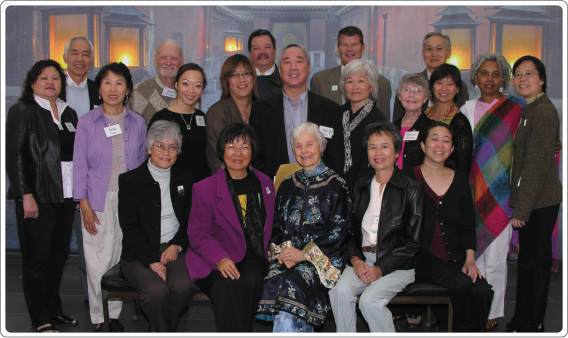
Thank you for your interest in leaving a legacy gift to either Donaldina Cameron House and/or Cameron House Foundation! Including either organization in your estate plans admits you into the Cameron House Legacy Circle, an elite group of visionary alumni and friends who believe in and want to sustain Cameron House’s mission and work for generations to come. Legacy Circle members receive special recognition in our Annual Reports and website, donor perks and behind-the-scenes updates, and exclusive or early access to Cameron House events. Not only do we want to celebrate your thoughtful commitment in life, but we also want you to feel connected to our plans and proud of your future investment.
You Can Support Cameron House in Two Remarkable Ways
Understanding where your legacy gift is directed is essential. It ensures that your generosity aligns fully with your intentions and allows us to steward your gift with clarity, care, and integrity.
Giving to Donaldina Cameron House, tax ID 94-1618605
A planned gift designated to Donaldina Cameron House supports the organization’s immediate and ongoing needs—funding essential programs, staffing, community outreach, and the care and maintenance of our historic building. These gifts are often unexpected, unrestricted, and can be deeply transformational, allowing the current Cameron House board and staff to respond to urgent needs, sustain its day-to-day work, and power the current strategic plan in real time. Legacy gifts to Donaldina Cameron House are often put to work in the same fiscal year in which the gift was received.
Giving to Cameron House Foundation, tax ID 94-2978157
A gift designated to Cameron House Foundation, by contrast, is invested for long-term impact. These funds are pooled and invested as part of an endowment, with earnings providing a steady, ongoing source of support to Cameron House. In addition to annual distributions, the Foundation Board of Directors may approve additional grants for significant needs—such as a portion of capital projects or emergency support—helping ensure the organization’s strength and sustainability for generations to come.
Or Include BOTH in your Planned Gift: Helping Today and Securing Tomorrow
Some members of the Legacy Circle choose to support both Donaldina Cameron House and Cameron House Foundation—making a gift that meets today’s needs while also investing in the future. We welcome and honor that approach as well.
Next Steps
No matter which organization or combination of support you choose, it is critical that your intentions are clearly expressed to your estate legal team, your family, and executor(s). We’ve made it easy for you to do just that.
Click on the link below to be taken to the Planned Gift Intention and Legacy Circle Interest form. There, you can establish—or renew existing—intentions. Upon submission of this non-legally binding form, you’ll be emailed a pdf of your answers that can then be shared with your family and estate planning attorney.
Together, we can build a lasting legacy—one that sustains our work and strengthens our community for generations to come.
Need Help?
Schedule a meeting
You can speak to Kim Lan Grout, Cameron House’s Chief Advancement Officer; Craig Lee, Chair of the Legacy Circle Committee; Tom Pong, Board Chair of Cameron House Foundation; or any combination of these three. We all work together to sustain Cameron House’s mission and work, and are eager to match your wishes with the best organizational fit. Click the link below to schedule a meeting with Kim Lan. In the notes sections, please indicate with whom (Kim Lan, Craig, and/or Tom) you’d like to speak and in what capacity (in person, phone or video call). We’ll do our best to accommodate your request in a timely fashion.
Attend the FREE Webinar on May 21, 2026, 6pm: DCH or CHF? Which Do I Choose?!
The Cameron House Legacy Circle invites you to attend a free and informative webinar exploring the differences between a planned gift designated to Donaldina Cameron House and a gift designated to Cameron House Foundation. Kim Lan Grout, Cameron House’s Chief Advancement Officer; Craig Lee, Chair of the Legacy Circle Committee; Tom Pong, Board Chair of Cameron House Foundation will answer your questions in a casual group setting.
FAQ
To benefit Cameron House
a) Your planned gift will directly benefit Cameron House programs, the youth, and social services clients we serve everyday and have for over 150 years.
b) Whether you choose to give to Donaldina Cameron House or Cameron House Foundation, your gift will make an incredible impact
To benefit yourself and/or your heirs
a) Save taxes today by donating appreciated stocks
b) Receive an income stream today, and leave the remainder to CH
c) Provide income stream to CH, and leave remainder to your heirs
To leave a legacy
a) If you choose, your gift will be publicly acknowledged and communicated
b) You can designate how your gift will be used to benefit CH
c) Your support of CH will continue in to the future
To make a larger gift than you can make from your current income
a) By using your assets today
b) By naming Donaldina Cameron House, Cameron House Foundation, or both in your will
Cash Gift
Non-cash asset: Different non-cash assets may require different processes for receiving them or assessments for determining their worth. The donor receives a charitable deduction for the full market value of the asset, and pays no capital gains tax on the transfer. Examples of non-cash assets:
a) Real estate
b) Life insurance policies
c) Retirement accounts or annuities
d) Stocks
e) Art or other collections
Great question—and a very common one.
- Donaldina Cameron House uses planned gifts to support immediate needs—programs, staffing, community services, and building upkeep. These gifts often have a direct and visible impact right away.
- The Cameron House Foundation invests planned gifts for the long term, often as part of an endowment. These funds grow over time and are used strategically to support Cameron House in a sustained fashion.
There’s no single “right” answer—it depends on your goals.
- If you want to support immediate impact, Donaldina Cameron House may be the best fit.
- If you want to support long-term sustainability, the Foundation may be a better match.
- Many members choose to give to both, balancing present needs and long-term sustainability.
Clarity ensures your gift is used exactly as you intend.
If your documents don’t clearly name the organization (Donaldina Cameron House vs. the Cameron House Foundation), it can create confusion or delay in carrying out your wishes. We always encourage members to review their plans with their attorney to ensure everything is clearly written.
In honor of someone — If someone at CH made a difference in your life, this would be a special way for you to honor them.
When you are a young professional — ask your current employer about employee gift matching.
At retirement age – If you have extra income, donate it back to Cameron House and reflect on the changes it made on your life.
A “beneficiary” is a person or entity, such as Cameron House, that receives money or other property from your estate. Beneficiaries are listed in a will, and the money they receive may come from a life insurance policy, retirement account or other kinds of assets.
Step 1: Make sure you properly identify Donaldina Cameron House, tax ID 94-1618605, located at 920 Sacramento Street, San Francisco, California, 94108, as the charity to be listed correctly in your financial documents.
Step 2: List Donaldina Cameron House as a beneficiary in your will or trust. If you are leaving personal property or money to Cameron House, specify the items or amount of money you are leaving. If you are bequeathing a life insurance policy or IRA account to Donaldina Cameron House, you’ll need to modify your account documents with the custodial institution that holds the account. However, also list the bequest in your will to ensure that Donaldina Cameron House receives the gift. Notify the executor of your will that you’ve named Donaldina Cameron House as a beneficiary, and let the executor know where a copy of your will can be found upon your death.
Step 3: Contact the institution that issued an insurance policy, IRA or other financial asset you wish to leave to Donaldina Cameron House. The institution will provide you with paperwork to add a beneficiary. Fill out the paperwork in full and attach any documentation required by the institution. Return the paperwork and request a copy of the paperwork once it has been accepted and filed. Check the paperwork to verify its accuracy.
A “beneficiary” is a person or entity, such as Cameron House Foundation, that receives money or other property from your estate. Beneficiaries are listed in a will, and the money they receive may come from a life insurance policy, retirement account or other kinds of assets.
Step 1: Make sure you properly identify Cameron House Foundation, tax ID 94-2978157, also located at 920 Sacramento Street, San Francisco, California, 94108, as the charity to be listed correctly in your financial documents.
Step 2: List Cameron House Foundation as a beneficiary in your will or trust. If you are leaving personal property or money to Cameron House, specify the items or amount of money you are leaving. If you are bequeathing a life insurance policy or IRA account to Cameron House Foundation, you’ll need to modify your account documents with the custodial institution that holds the account. However, also list the bequest in your will to ensure that Cameron House Foundation receives the gift. Notify the executor of your will that you’ve named Cameron House Foundation as a beneficiary, and let the executor know where a copy of your will can be found upon your death.
Step 3: Contact the institution that issued an insurance policy, IRA or other financial asset you wish to leave to Cameron House Foundation. The institution will provide you with paperwork to add a beneficiary. Fill out the paperwork in full and attach any documentation required by the institution. Return the paperwork and request a copy of the paperwork once it has been accepted and filed. Check the paperwork to verify its accuracy.
That’s a very fair question, and we appreciate your raising it.
Over time, as Donaldina Cameron House and the Cameron House Foundation have both grown and evolved, the distinction between the two—especially in the context of legacy giving—has become more important to clarify.
Up until now, all planned gifts of a certain size were placed into the Cameron House Foundation. We realize, though, that not all legacy donors want their gifts to be utilized that way. We are now making an intentional effort, as the Legacy Circle grows, to make clear that donors have—and have always had—a choice and we are committed to stewarding their wishes exactly as they’d intended.
We may not have consistently or proactively communicated this difference as clearly as we should have.
As part of our commitment to strong stewardship, we want to ensure all Legacy Circle members have the information needed to make fully informed decisions. Our goal is to honor your intentions with clarity and care, and we’re grateful for the opportunity to revisit and confirm your wishes together.
Yes.
You can let me know now your clear intentions, and I can update the information we have in our system. I will note, too, that you gave me your verbal confirmation on this date.
If you’d like to take a step further beyond a verbal confirmation, I can email or mail you a simple form on which you can clarify where your planned gift is directed. You can sign, date, and return the form to us so we can update our records.
Additionally, you should make sure your intentions are clear on your estate plans, likely via your attorney.
That’s completely fine—this is a thoughtful process, and there’s no pressure. We’re here as a resource and are happy to talk through options whenever it’s helpful.
A gift to either organization ultimately benefits Cameron House’s mission, programs, and services. You’re included in the Legacy Circle, with its member perks, no matter which organization you intend.
Our priority is to make sure your gift will be directed exactly as you intend.
With a legacy donor’s explicit permission, we recognize their generosity as part of the Legacy Circle. This information, usually written as the “Estate of [Donor’s Name]” unless specified otherwise, is memorialized on our website.
Recognition is always guided by your preferences.
You can always reach out to the Advancement team at:
advancement@cameronhouse.org
Absolutely.
You can request a one-on-one conversation (phone, video, or in person) anytime here by clicking the “Schedule an Appointment” button above.
You can choose to speak with Kim Lan Grout from the Donaldina Cameron House Advancement Department, a Legacy Circle Committee member, or a board member of the Cameron House Foundation. We’re all collaborating on this outreach and are aligned in the goals and messaging.
Yes. In addition to this outreach…
- You can continue this conversation with either Kim Lan Grout from the Donaldina Cameron House Advancement Department; Craig Lee, Chair of the Legacy Circle Committee; or Tom Pong, Board Chair of the Cameron House Foundation.
- Members of the Legacy Circle Committee will be in attendance at the June 13 Picnic in the Park and available to talk more.
- We’ll also be hosting a webinar on May 21, 2026, 6pm, to walk through these topics and provide additional clarity in a group setting.
Foundation gifts are invested with the intent to grow over time. A planned gift to the Cameron House Foundation is a gift that keeps on giving. Your gift is managed as an endowment, keeping the principal amount intact while revenue generated by interest or investments are distributed to Cameron House on an annual basis to fulfill the mission of Cameron House. Therefore, your gifts live infinitely providing an ongoing source of income year after year.
Actuarial – A science that applies mathematical and statistical methods to calculate the value of lifetime payments for planned giving, and assess risk in life insurance and other financial areas.
Adjusted Gross Income (AGI) – In the United States income tax system, adjusted gross income (AGI) is an individual’s total gross income minus specific deductions. Taxable income is adjusted gross income minus allowances for personal exemptions and itemized deductions. For most individual tax purposes, AGI is more relevant than gross income.
Annuity – An annuity is a series of payments made at equal intervals. Examples of annuities are regular deposits to a savings account, monthly home mortgage payments, monthly insurance payments and pension payments. Annuities can be classified by the frequency of payment dates. The payments (deposits) may be made weekly, monthly, quarterly, yearly, or at any other regular interval of time.
Appraisal – The process of developing an opinion of value for real property (usually market value). Real estate transactions often require appraisals because they occur infrequently and every property is unique, unlike corporate stocks, which are traded daily and are identical. The location also plays a key role in valuation. However, since property cannot change location, it is often the upgrades or improvements to the home that can change its value. Appraisal reports form the basis for mortgage loans, settling estates and divorces, taxation, and so on. Sometimes an appraisal report is used to establish a sale price for a property.
Appreciated Property – A property or security that has risen in value since the last change in ownership. Generally, appreciated property held by the donor for more than a year may be donated at full fair market value with no capital gains cost.
Basis – The original purchase price of an asset, used for tax purposes.
Beneficiary – A person who receives the benefits from a will, trust, or life insurance policy.
Bequest – Property or cash given to a person or institute through a will.
Capital Gains Tax – A tax levied on profit from the sale of property or of an investment.
Codicil – A document that supplements, explains, or modifies a will – or a specific part of a will.
Cost Basis – See Basis, above.
Endowment Fund – A donation of money or property to a nonprofit organization for the ongoing support of that organization. Usually the endowment is structured so that the principal amount is kept intact, while the investment income is available for use, or part of the principal is released each year, which allows for their donation to have an impact over a longer period than if it were spent all at once. An endowment may come with stipulations regarding its usage.
Estate Tax – A federal tax placed on the net value of the estate of a deceased person before distribution to the heirs.
Executor – A person responsible for executing the terms of a will.
Fair Market Value – An estimate of the market value of a property, based on what a knowledgeable, willing, and unpressured buyer would probably pay to a knowledgeable, willing, and unpressured seller in the market.
Grantor – A person who creates a trust and transfers property into it.
Interest Income – The amount of interest that has been earned during a specific time period.
Inter Vivos Trust – A trust that is created during the settlor’s lifetime by a trust instrument.
Intestate – Intestacy is the condition of the estate of a person who dies without having made a valid will or other binding declaration. Alternatively this may also apply where a will or declaration has been made, but only applies to part of the estate; the remaining estate forms the “intestate estate”.
K-1 (also 1099-R) – The IRS forms sent to life-income gift participants detailing how payments they received from their gifts during the year will be taxed.
Life Expectancy – A statistical measure of the average years an individual is expected to live.
Life Income Gift – An irrevocable arrangement of property transfer to a nonprofit/charity from a donor, where the donor retains the income interest to his/her benefit.
Personal Property – Personal property is movable and can be understood in comparison to immovable property or real property, such as land and buildings. Securities and artwork fall into the personal property category.
Personal Representative – See Executor, above.
Planned Giving – Planned gifts are referred to as such because they require more planning, negotiation and counsel than many other gifts. Planned gifts can result in immediate income, income to charity over time or serve to delay a gift for life or other period of time while the donor or others retain income and/or access to the assets used to fund the gift. Because of the current or future charitable benefits, a number of state and/or federal income tax, capital gains, estate, and gift benefits are associated with giving in this way.
Present Value – The value of an expected income stream determined as of the date of valuation. The present value is always less than or equal to the future value because money has interest-earning potential, a characteristic referred to as the time value of money, except during times of negative interest rates, when the present value will be more than the future value.
Probate – The judicial process whereby a will is “proved” in a court and accepted as a valid public document that is the true last testament of the deceased.
Remainder Interest – A future interest given to a person (who is referred to as the transferee or remainderman) that is capable of becoming possessory upon the natural end of a prior estate created by the same instrument.
Remainderman – A person who inherits or is entitled to inherit property upon the termination of the estate of the former owner. Usually this occurs due to the death or termination of the former owner’s life estate, but this can also occur due to a specific notation in a trust passing ownership from one person to another.
Testamentary Trust – A trust which arises upon the death of the testator, and which is specified in his or her will. A will may contain more than one testamentary trust, and may address all or any portion of the estate.
Testator – A person who creates a will.
Trust – An agreement whereby one party (the trustee) agrees to hold ownership of a piece of real property for the benefit of another party (the beneficiary).
Trustee – Anyone in a position of trust and so can refer to any person who holds property, authority, or a position of trust or responsibility for the benefit of another. A trustee can also refer to a person who is allowed to do certain tasks but not able to gain income.

Read more here!
Interview: Interview with Tom Pong, Alumnus & Legacy Society Member
https://cameronhouse.org/interview-with-alumnus-legacy-society-member-tom-pong/
Article: Leave a Lasting Legacy: How RMDs Can Support Cameron House
https://cameronhouse.org/leave-a-lasting-legacy-how-rmds-can-support-cameron-house/